KAFA - Enough is Enough
Shedding Light on Gender-Based Violence in Canada’s Arab Community
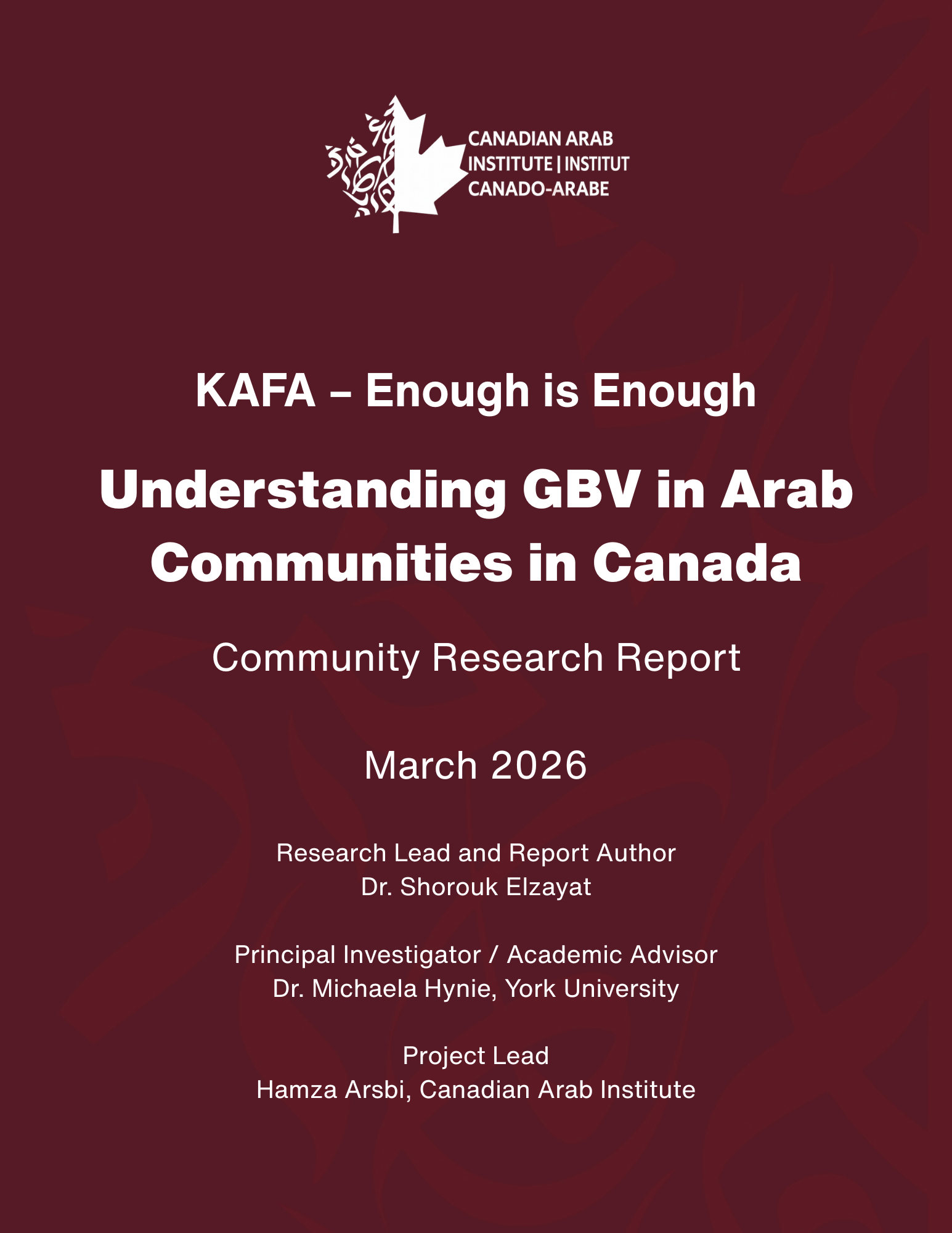
Kafa, which translates to “enough” in Arabic, was a community-driven research initiative (March 2024–March 2026) that set out to understand and address gender-based violence (GBV) within Canada’s Arab community. With Phase One now complete, KAFA has produced one of the first robust, community-rooted evidence bases on GBV in Canadian Arab communities.
HOW THE RESEARCH WAS DONE
KAFA used a mixed-methods, participatory approach led by Dr. Shorouk Elzayat, with Dr. Michaela Hynie (York University) as academic advisor. It combined a national survey of approximately 700 self-identifying Arab community members across Canada—administered with Ipsos in English, French, and Arabic—with eight in-depth interviews with service providers who support Arab and immigrant women experiencing violence. The survey used a trauma-informed, survivor-centric design with content warnings and opt-out options.
WHAT WE FOUND
GBV is widely recognized but often hidden. About 51% of respondents believe GBV is common in the community, and nearly half reported experiencing at least one form of GBV in their lifetime. Emotional and psychological abuse was the most commonly reported form, frequently alongside patterns of control, financial dependency, and social isolation.
Awareness does not equal trust. Even when survivors know services exist, many don’t trust or feel safe using them. Concerns about family reputation, cultural stigma, and fear of retaliation remain significant barriers, and 22% of respondents were unaware of any GBV support services. Service providers also pointed to misinformation about legal consequences, fear of losing custody of children, language barriers, and mistrust of institutions.
Community-rooted solutions work best. Survivors and providers consistently identified anonymous helplines, counselling, peer support, and survivor advocacy as more effective than purely institutional responses.
WHERE WE GO FROM HERE
KAFA’s findings point to approaches that extend beyond crisis response—strengthening community education, building culturally responsive services, and rebuilding trust between communities and institutions. The full report sets out detailed recommendations to guide future policy, programming, and systems-level change.
This project was funded by Women and Gender Equality Canada.
CONTACT US
For inquiries, contact info@canadianarabinstitute.org
This project would not have been possible without funding from Women and Gender Equality Canada

Outcomes
Nearly half of Arab Canadians have experienced some form of gender-based violence
Younger Voices (25–34) Are Breaking the Silence:
Higher reporting among younger respondents likely shows growing awareness, not rising incidents.
Help-Seeking Crisis:
Half of survivors try to seek help… but just 28% find it "completely adequate."
Healthcare providers = most trusted
Police & religious institutions = most discomfort
Women Survivors Want Community-Driven Solutions.
Preferred paths:
Anonymous helplines
Counselling
Peer support groups
Survivor role models & advocacy
These community-rooted, culturally sensitive paths seem to prove far more effective than institutional solutions for shifting gender norms and providing higher access to support.
Reaching out for support following incident
Among those who have experienced some form of violence: half (49%) said they reached out for support following the experience while half did not
Men (55%) were more likely to report that they reached out for support compared to women (43%)